Tonight on AxXiom For Liberty Live Mark Lerner, Real ID/Biometric Expert on Biometric ID in Immigration Reform Bill

a4l 55

Kaye Beach

May 17, 2013

Tonight on AxXiom For Liberty Live with Kaye Beach and Howard Houchen  6-8 PM Central – International Biometric ID for All if Immigration Reform Bill Passes
Listen Live-LogosRadioNetwork.com  click ‘Listen’ then choose your Internet speed.  Logos Radio Network is a listener supported, free speech radio network and your contributions are vital but you do not have to be a subscriber in order to hear the show.

There is much conflicting information being bandied about regarding the immigration reform bill (.744, the ‘Border Security, Economic Opportunity, and Immigration Modernization Act’)

Let’s clear the fog.

Mark Lerner is the co-founder of The Constitutional Alliance, and the nation’s leading expert on biometrics and the Real ID Act.  He will tell us exactly what is and isn’t in the bill and what it all means for us.  Don’t miss this opportunity to get the straight truth about S.744!

Howard and I will also be discussing a variety of important topics and taking your calls.

Your questions or comments are always welcome!
CALL IN LINE 512-646-1984
Miss a show?  Get the Podcast!  Archives here
Other ways to listen;
Listen to Logos Radio Network on SHOUTcast
iTunes-AxXiom For Liberty and other great Logos Radio Network shows can be accessed by iPhone and iPad on iTunes!  Just search iTunes for “AxXiom For Liberty” or “Logos Radio Network”
************************************
global biometric id

Your photo in your state driver’s license or ID card IS a Biometric

Mark Lerner explains:

Biometric is defined as: Measurements of the body. There are both physiological and behavioral biometrics.  For the sake of this document the focus will be on facial recognition and photographs.

There has been a great deal of conversation and equal amount of confusion about whether a photograph of an individual is a biometric.   The answer is “yes”.  Whether the photograph is an analog (old Polaroid photos) or a digital photograph, a photograph is a biometric.  The question becomes why are digital facial images/photographs now used instead of the older analog photos that were used on driver’s licenses and other identification documents?  The simple answer is the accuracy of the matching or comparison between one photograph and another is greatly increased when working with digital facial images.

One way to examine the question of whether a photograph is a biometric is by looking at photographs and fingerprints.  It is widely accepted to the point of being undisputed, that a fingerprint is a biometric.  Consider that when a person places a finger on a ink pad and then places that same finger on a piece of paper, the result is a fingerprint on the piece of paper.  Now let’s look at a photograph.  The photograph of a person’s face the equivalent of fingerprint, only the photograph is a representation of a person’s face instead of their finger tip.

Just as there are fingerprints that are not of sufficient quality to allow for computer automated comparisons, the same is true of photographs.  It is for this reason that we see standards for the collection of both fingerprints and photographs.  These “standards” are the minimum acceptable standards for the computer automated analysis/comparison.

The question of whether a photograph is in itself a biometric is especially important today because of the use of facial recognition software.  Facial recognition (software) in its simplest terms is described as follows:

Facial recognition systems are computer-based security systems that are able to automatically detect and identify human faces. These systems depend on a recognition algorithm, such as eigenface or the hidden Markov model. The first step for a facial recognition system is to recognize a human face and extract it fro the rest of the scene. Next, the system measures nodal points on the face, such as the distance between the eyes, the shape of the cheekbones and other distinguishable features. These nodal points are then compared to the nodal points computed from a database of pictures in order to find a match. Obviously, such a system is limited based on the angle of the face captured and the lighting conditions present. New technologies are currently in development to create three-dimensional models of a person’s face based on a digital photograph in order to create more nodal points for comparison. However, such technology is inherently susceptible to error given that the computer is extrapolating a three-dimensional model from a two-dimensional photograph.  http://epic.org/privacy/facerecognition/

Today in the United States and in other countries there has been a great deal of discussion about “facial recognition” in particular and more generally “surveillance”.

It is not widely known that all states in the United States are “capturing” a digital facial image/photograph that is facial recognition compatible.   Real ID compliant and non-Real ID compliant states use the same standard for the digital facial image/photograph capture.  Every state works with AAMVA (American Association of Motor Vehicle Administrators).  AAMVA has adopted the ICAO (International Civil Aviation Organization) standard that is required by the Real ID Act (page 68, footnote 17, Notice of Proposed Rule Making, Real ID Act 2005).  In addition, the vendors who have been awarded state driver’s license contracts have adopted the same standard as called for in the Real ID Act 2005.

The following is the wording that articulates the standard for AAMVA, the vendors who have been awarded state driver’s license contracts and the Real ID Act 2005.  This wording is taken from page 68, footnote 17 of the Notice of Proposed Rule Making for the Real ID Act 2005.

“The relevant ICAO standard is ICAO 9303 Part 1 Vol. 2, specifically ISO/IEC 19794-5 – Information technology -Biometric data interchange formats – Part 5: Face image data, which is incorporated into ICAO 9303.”

In conclusion, there should no longer be a question in anyone’s mind that the photographs of a person’s face which are contained in every respective state Department of Motor Vehicle photo database is a biometric.

OK-SAFE: Help Stop Common Core in Oklahoma – Calls Needed!

Kaye Beach

May 17, 2013

Via OK-SAFE:


Help Stop Common Core in Oklahoma – Calls Needed!

OK-SAFE, Inc. – By now everyone knows how dangerous the Common Core State Standards are for our children and state education.  (See here, here, here, here, and here.)

Everyone, that is, except OK Governor Mary Fallin, State Superintendent Janet Barresi, and Senator John Ford.

It appears that OK Speaker T.W. Shannon has come out against the Common Core state standards and is willing to run legislation (hopefully this session) to repeal one of the components of this egregious education system.  (HB 1719 may end up being the legislative vehicle for the repeal of the Common Core standards bill, but that has not been confirmed as of this writing.)

Please call your Senator and Representative and tell them you want Common Core repealed in Oklahoma.  Especially, call and email Pro-Tem Brian Bingman and Sen. John Ford and tell them to say YES to the repeal of the Common Core in Oklahoma.

  • Senate Pro-Tem Brian Bingman   405-521-5528   Email: bingman@oksenate.gov
  • Sen. John Ford                                 405-521-5634  Email: fordj@oksenate.gov

Read more

Louisiana Senators Want to Cave to Real ID – Push Back LA!

states oppose real id 2012 ncsl

Kaye Beach

May 15, 2013

In 2008 – Louisiana Prohibits Implemantation of the Federal REAL ID Act    HB 715 “The Legislature of Louisiana does hereby direct the Department of Public Safety and Corrections, including the office of motor vehicles, not to implement the provisions of the REAL ID Act . . .”

Now some uncharacteristically weak-kneed Louisiana Senators want to overturn the state’s hard won anti-real ID law.

la power coalition

What this journalist neglected to report in the following article is that  the freedom loving citizens of the great state of Louisiana are not very happy with this capitulation to DHS’s “Big Sis”  Sec. Napolitano and they were there today to register their displeasure.

Members of the Louisiana Power Coalition showed up at the committe hearing today and made thier voices heard.  If you or someone you know lives in LA and prefer to remain Real ID free, contact the Louisiana Power Coalition and find out what you can do to help stop Real ID in LA!

If you want to watch the SENATE TRANSPORTATION, HIGHWAYS AND PUBLIC WORKS COMMITTEE  procedings here is the link to the video The bill is SB 395 and it is this amendment to that bill that they are discussing the discussion begins at about 7 minutes.  Three members of  Louisiana Power Coalition speaks out at abot 28 minutes.

By the way, Senator Adley is mistaken.  Diane Long for the Louisiana Power Coalition was accurate in het statement that the photos currently collected for driver’s licenses in LA is indeed,  a biometric. 

As explained by Mark Lerner, co founder of the Constitutional Alliance and the leading expert on the Real ID Act and biometrics in the US;

It is not widely known that all states in the United States are “capturing” a digital facial image/photograph that is facial recognition compatible.   Real ID compliant and non-Real ID compliant states use the same standard for the digital facial image/photograph capture.  Every state works with AAMVA (American Association of Motor Vehicle Administrators).  AAMVA has adopted the ICAO (International Civil Aviation Organization) standard that is required by the Real ID Act (page 68, footnote 17, Notice of Proposed Rule Making, Real ID Act 2005).  In addition, the vendors who have been awarded state driver’s license contracts have adopted the same standard as called for in the Real ID Act 2005.

La. Senate panel backs bill that would use state-issued driver’s license as national ID card

BATON ROUGE, Louisiana — Louisiana driver’s licenses would be used to comply with federal law requiring each state to create a national identification card for air travel, including domestic flights, under a proposal inserted Wednesday into a House bill by the Senate Transportation Committee.

Senators added that language into a separate measure by Rep. Johnny Guinn, R-Jennings. If approved by lawmakers, the provision would reverse a state stance since 2008 rejecting the added security requirement as too intrusive.

Officials with the state motor vehicles department said that if the state doesn’t comply with the federal Real ID law, residents would need passports to fly starting in October.

“Whether we like it or not, we’re stuck with it,” said Sen. Robert Adley, R-Benton, committee chairman. “It’s better to deal with it like this.”

. . .

Under the proposal, federally compliant driver’s licenses would be stamped with a Department of Homeland Security gold star emblem and would require that residents present additional documentation, such as a birth certificate or a Social Security card, to state motor vehicle officials when applying for a license or a renewal.

That information would be entered into a national database.

Read more

http://www.therepublic.com/view/story/f03cae496103400689de3e0f02cebb71/LA-XGR–Real-ID-Louisiana

The Immigration Reform Bill – Prodding Forth Real ID, an INTERNATIONAL Biometric ID

global biometric id

Kaye Beach

May 14, 2013

On May 10th The Blaze ran a headline that asks; Is There a Scary Biometric ‘National ID System’ Tucked into the Immigration Bill?

The answer is YES!

But wait!  There’s more. . .I sometimes feel like I am belaboring the point but it seems to me the distinction between a national and INTERnational biometric identity system is a very important one.

Study that graphic up there.  It is the simple three step recipe for a single, global biometric identification system.  Read this post then look at it again and see if you can grokk what I’m telling you.

The federal Real ID Act of 2005 imposed federal guidelines that use international standards on state driver’s licenses and ID cards.  You may remeber that at least 25 states said no to Real ID by passing either a law or a resolution against the implementation of the Real ID Act.  Nevertheless, Real ID has continued to be implemented in most states to various degrees.

“By the deadline of January 13, 2013, most states will be substantially or materially or fully compliant with REAL ID” –Janice Kephart, Feb. 2012

It is important to note though, that ALL states are capturing and storing applicants’ digital facial images.  And although not all of the states are actually using this facial biometric as intended by the Real ID Act, eventually they will be.   The immigration reform bill (S.744, the ‘Border Security, Economic Opportunity, and Immigration Modernization Act’) will make sure of it.

In case you missed it, now, when you apply for a state driver’s license, a state identification card or any other form of government issued photo ID really, you are having your facial biometrics captured by a high resolution photograph.  High resolution digital cameras capture, map, digitize and database our facial features for the purpose of use by facial recognition technology.

Facial recognition technology enables remote identification and tracking through networked camera systems without our knowledge or consent.  As a matter of fact, facial biometrics is the governments biometric of choice because it can be used to identify and investigate us at-a-distance without our knowledge or consent.

Pay close attention here: This digital image on your state driver’s license or ID card is, by definition, a biometric.

The standard specified in the Real ID regulations for your state driver’s license and ID cards ensures that the digital facial image is facial recognition compatible.  That standard is the adopted standard of the ICAO, the International Civil Aviation Organization, an agency of the UN.

(Want more information?  Read REAL ID – BIOMETRIC FACT SHEET)

International standards exist for one purpose;  to enable the global sharing of that information.

REAL ID is. . .the current face of a far larger, international government and private economic effort to collect, store, and distribute the sensitive biometric data of citizens to use for the twin purposes of government tracking and economic control.” -PA Rep. Sam Rohr

Real ID is technically voluntary for the states.  What the government has always intended, is for Real ID to be practically mandatory for the citizens.  This is why the threat hangs over our heads that if we do not have a Real ID card by a certian date, we will not be able to fly or enter a federal building.

“In the future, only those state issued Driver Licenses and  Identification cards which are fully compliant with the REAL ID act of 2005 will be authorized for use as identification for official federal
government purposes, such as boarding commercial aircraft and entering  certain regulated federal facilities.” Alabama DMV-STAR ID

The road to Real ID compliance has admittedly been a rather slow and arduous one but the Immigration Reform bill (S.744, the ‘Border Security, Economic Opportunity, and Immigration Modernization Act’), if passed, will put a stop to any state foot dragging on Real ID because citizens will have to have it in order to work!

 A Real ID compliant driver’s license is specifically named as one of the acceptable ID documents in the bill (but all ID documents specified in the bill are biometric ID’s.)

To be perfectly clear – with S.744, producing your government issued, internationally standardized biometric ID is mandatory.  You will not be able gain permission to work without it. 

In authoritarian societies you must always have permission.

Forget privacy.  That is not what this is about.  This is about the balance of power between us and our government.  This is about control.  If we wish to retain control over our own lives, we will not accept government serializing of our bodies and we won’t allow the government to turn our rights into privileges

The Sec. of the Dept. of Homeland Security also has the option to add any other biometric or security feature as a requirement for those who wished to be employed so facial biometrics is the minimum biometric requirement but iris scans, fingerprints, or any other biometric could be required as well.

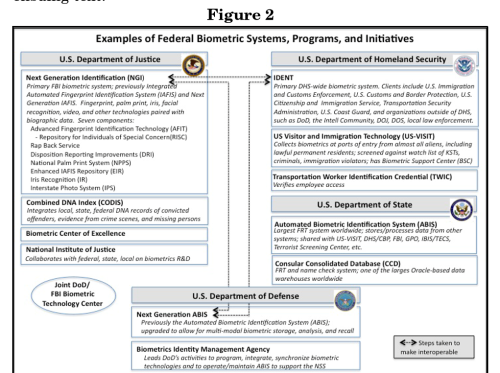
The new comprehensive immigration reform bill is not the first step in enrolling US citizens in the global biometric identification system.  The first step was that every government issued ID (especially the driver’s license) captured and collected your biometric data and that that data was collected in accordance with international standards.  The second step is to share your biometric data, to connect databases so that they can get that data flowing freely from the state and local databases on to the federal ones and eventually into global data systems.

One other important step in this global system of identification and control is to make sure we have to produce our global biometric ID for everything.  Or at least everything that we do that government wants to track and control.  And don’t forget that with biometric ID, your body IS your ID.  It’s the databases and not the card we should be focusing on.

Here are a few more facts about the bill as drafted;

Requires ALL potential employees to be authorized to work through the Dept. of Homeland Security.  Even If you are already employed when the proposed law goes into effect, you still will have to go through this authorization process.

Authorization hinges upon biometric identification.  Biometric data, including but not necessarily limited to, digital facial image, is required.  Real ID compliant driver’s licenses are cited as one acceptable form of biometric ID but the bill leaves the door open for the Sec. of the Dept. of Homeland Security to add other security requirements as he or she see fit.

The immigration reform bill requires employers to use a “photo tool” to verify the identity of each employee.  The term ‘photo tool’ is simply a euphemism for facial recognition software that will be used to match the facial biometrics provided by the potential employee to a federal database.

Where will this federal database come from?  I asked this question of Mark Lerner, co-founder of The Constitutional Alliance,  the leading expert on biometrics and the Real ID Act.

Here is his reply:

 “The answer will come in the Rulemaking process. There are two possible scenarios. In either scenario the “key” will be the photos stored in state DMV databases. Whether it will be DHS requiring employers to send photos to DHS and DHS having direct or indirect access to state DMV photo databases or whether DHS will require the photos the employers uses to be provided directly to states for the states to compare to photos in the state DMV database remains unclear. I also believe it is clear DHS will get the photo regardless.”

Access to the biometric data held in state DMV databases will be a must. 

There are reasons I have been having a fit trying to get my biometric data OUT of the state Department of Public Safety database.  I think this bill goes a long way in making my argument for me.  Read more about my lawsuit against the state of Oklahoma for the unwarranted collection of my biometric data here.

There is more to this bill to be concerned about  For instance,  the unconstitutional lack of due process.  Every person must prove they are a US citizen before they can work.  If the system says you do not pass muster, you are required to be terminated from your job at the end of an administrative process.   Will have more info on this and other issues soon.

ultimate control whitehead

Predators in Your Backyard?

florida panther

Kaye Beach

May 14, 2013

“Across the world scientists are releasing predators, nature’s ultimate killers, close to where people live.”

This 2010-11 BBC documentary, Predators in Your Backyard, shows how “Rewilding” is being accomplished in the US and other places.  They state up front that this is a dangerous experiment but strangely fail to show the real downsides to the actual project. (You can watch the film here)

For instance, the BBC film would leave you believing that the reintroduction of wolves in the west has been an unparalled success.  If you want to get a second opinion watch this documentary, also released in 2011, called Crying Wolf.

The Predators in Your Backyard gives the viewer the impression  that efforts to reintroduce predators such as the wolf, bear and panther, into areas of human habitation are edgy projects but also entirely noble ones.

At the tail end of the film we get a hint of the truly radical nature of ”Rewilding” when Prof. Felisa A. Smith of the University of New Mexico suggests that the  wild horse population in the the western US might be better managed by the introduction of african lions.  (This part of the film made for an entertaining topic on the CityData.com forum)

Predators in Your Backyard is a documentary intended to warm us up to a plan that few would approve of if they knew the whole story.  Here is a little more information for your consideration.

Rewilding is part of the Wildlands Project.

The Wildlands Project ;
Core reserves
are wilderness areas that
supposedly allow biodiversity to flourish. “It is
estimated,” claims Noss, “that large carnivores and
ungulates require reserves on the scale of 2.5 to
25 million acres. …For a minimum viable population
of 1000 (large mammals), the figures would be 242
million acres for grizzly bears, 200 million acres
for wolverines, and 100 million acres for wolves.
Core reserves should be managed as roadless areas
(wilderness). All roads should be permanently
closed.”

Even more about the Wildlands Project can be found here

Tonight on AxXiom For Liberty Live! 6-8 PM Narconon in Our Schools, Gov. Ed Money Pit and Loopy Legislation

a4l 55

Kaye Beach

May 10, 2013

Tonight on AxXiom For Liberty with Kaye Beach and Howard Houchen Narconon in Our Schools,  Gov. Ed Money Pit  and Loopy Legislation

Listen Live-LogosRadioNetwork.com  click ‘Listen’ then choose your Internet speed.  Logos Radio Network is a listener supported, free speech radio network and your contributions are vital but you do not have to be a subscriber in order to hear the show.

We are going to cover a lot of ground tonight.

First up are Colin Henderson and David Love,  returning guests to AxXiom For Liberty.  Colin and David are two untiring activists seeking to expose the deceptive and dangerous practices of Narconon and Scientology.

Colin Henderson sought help for his addiction at Narconon Arrowhead, a drug rehabilitation facility located in Canadian Oklahoma, in 2007.  He quickly became a critic of Narconon for their practices which he says are both deceptive and dangerous.

David Love, originally from British Columbia, was both a client and a staffer at the Narconon rehabilitation facility in Trois-Rivieres, half way between Montreal and Quebec City. He left in disgust taking with him masses of documentation on fraud and abuse in Narconon (NN) Trois-Rivieres (TR) facility in 2009. On April 17, 2012, Quebec health officials ordered the Narconon in Trois-Rivières to close saying that Narconon’s methods were dangerous for patients and violated Quebec’s health and safety criteria governing rehabilitation centers.

Colin and David will get us up to speed on the latest news regarding Narconon and help shed light on some of Scientology’s more insidious practices such as the one Howard Houchen encountered recently.

Narconon is a Scientology based drug rehabilitation program with facilities located worldwide including the state of Oklahoma.  Scientology has many fronts but all roads seem to lead gaining more recruits and money to fill the coffers of the church of Scientology.  Even so, you would not expect to find a trace of Scientology in a public school in the sleepy little town of Hugo Oklahoma.  Howard knows better.  He is going to explain how Narconon came to his child’s school and what he did about it.

Brandon Dutcher, OCPA

We will also get to hear Howard’s interview with Brandon Dutcher, the Vice President of Policy at OCPA (Oklahoma Council of Public Affairs) an Oklahoma individual liberty, free market policy research organization.  Howard and Brandon discuss the 91 million tax-payer dollars recently bestowed upon Oklahoma’s education system.  Brandon says that it is sheer folly to keep giving more money to this ‘failed government monopoly.’

Take a look at the numbers in Brandon Dutcher’s article for OCPA on the issue;  Oklahoma’s monopoly education system gets more money

Amanda Teegarden, Exec. Dir. OK-SAFE

We are also very pleased to welcome back Amanda Teegarden, the Executive Director of OK-SAFE, Inc. (Oklahomans for Sovereignty and Free Enterprise).

They say nothing happens by accident in politics and I am beginning to believe that this is true.   In the legislative process at least, I’m ready to vouch for it.  Amanda is going to shed some light on the process by examining two recent pieces of legislation that caused some confusion and controversy.   I think you will find this peek behind the curtain very interesting.

I will be sure to add any relevant links and articles after the show.

CALL IN LINE 512-646-1984
Miss a show?  Get the Podcast!  Archives here
 
Other ways to listen;
Listen to Logos Radio Network on SHOUTcast
iTunes-AxXiom For Liberty and other great Logos Radio Network shows can be accessed by iPhone and iPad on iTunes!  Just search iTunes for “AxXiom For Liberty” or “Logos Radio Network”

Tonight on AxXiom For Liberty Live! Drones, Biometric Scans, Raid and Common Core – NOT OK Oklahoma!

a4l 55

*****Show Notes Below*****

Kaye Beach

April 26, 2013

Listen Live-LogosRadioNetwork.com  click
‘Listen’ then choose your Internet speed.
Logos Radio Network is a listener supported, free speech radio network and your contributions are vital but you do not have to be a subscriber in order to hear the show.

Tonight on Axxiom For Liberty with Kaye Beach and Howard Houchen – Drones, Biometric Scans, Raid and Common Core – NOT OK Oklahoma!

Howard and I are going to be catching up on some Oklahoma news items that will be of great interest to liberty lovers.

We are going to talk to Dax Ewbank about the FDA and the FBI raiding a Tulsa alternative cancer care clinic, discuss how a new hospital biometric identification system is causing problems for some conscientious employees and catch up on what is going on with the drones in Oklahoma.  We will also get an update on the Oklahoma push back against Common Core from Jenni White, Exec. Director of Restore Oklahoma Public Education.

And we want to hear from you!  Call us at 512-646-1984

 **************************Show Notes*********************

We spoke with Sam Bass whose wife Yvonne’s treatment was interrupted because of the FDA/FBI raid on Camelot Cancer Care, and asked how we could help.

Here is a link to the website where you can support Yvonne http://www.youcaring.com/medical-fundraiser/help-a-wonderful-mom-and-friend-naturally-finish-off-her-battle-with-cancer-/52172/update/39324

Keep up with all the anti-Common Core activities here – Restore Oklahoma Public Education -ROPE – on Facebook  https://www.facebook.com/pages/Restore-Oklahoma-Public-Education/116011401766695?fref=ts


**************************************************

Miss a show?  Get the Podcast!  Archives here
Other ways to listen;
Listen to Logos Radio Network on SHOUTcast
iTunes-AxXiom For Liberty and other great Logos Radio Network shows can be accessed by iPhone and iPad on iTunes!  Just search iTunes for “AxXiom For Liberty” or “Logos Radio Network”

FDA, FBI Raid Tulsa Cancer Clinic

Camelot Cancer Care center in Tulsa

Camelot Cancer Care center in Tulsa

Kaye Beach

April 25, 2013

The treatments offered at Tulsa’s Camelot Cancer Care enter were a last hope for some patients and their medications were taken right out of their hands. The video (at the link provided below) of the husband of a cancer patient interviewed, is heartbreaking.

The substance in question is Laetrile.

Back in the 1970′s,  the U.S. Food and Drug Administration examined the Laetril and found no significant safety issues with it but deemed Laetril ineffective and subsequently banned it. More than twenty states followed suit by legalizing the substance.  The debate surrounding the use of Laetril,  was and still is, huge.    Proponents of Laetrile say that the ban is all politics.

Whatever the case may be with this particular treatment, my question is do we have the right to choose our own medical treatments?

From Tulsa’s News on 6

TULSA, Oklahoma -

A U.S. Food and Drug Administration investigation shut down a Tulsa cancer clinic Tuesday afternoon. Federal agents showed up at Camelot Cancer Care in south Tulsa around 11 a.m. and served a search warrant.

Investigators have been tight-lipped about why they were there, but a source tells us the FDA is looking into the center’s use of Laetrile, and has a concern for the safety of its patients.

But one man speaks highly of Camelot and the natural chemical that he claims was saving his wife’s life.

“Listen, my wife’s dying, and we don’t want to go with chemotherapy and radiation,” said Sam Bass.

Read more and watch the video here

Integris Health Hospital Employee Balks at Patient Biometric Scans

palm vein

Kaye Beach
April 24, 2013

Almost no one would disagree that our government aided by its corporate partners, has become increasingly intrusive and data hungry. At every turn it seems we are being measured, monitored, tracked or surveyed in some way.  (If you are one of those who doesn’t care if you are constantly scrutinized by governments and corporations,  you can stop reading now.  I have no advice to offer you for your broken survival instinct.)

The level of surveillance of a population that will be achieved is predicated on four simple elements; 1) Money  2) Man power (or technology)  3) Political will  4) public acceptance of the surveillance.

For ordinary citizens who are alarmed about the implications of living in a pervasive surveillance state, element four, public acceptance, is the arena where we live or die and we know it. This is why I want to share with you one example of an ordinary citizen who has taken a stand in that arena.

Until yesterday, Maggie was a full time employee of INTEGRIS Hospital in Grove Oklahoma working in the patient registration department but the addition of a new biometric patient identification system at INTEGRIS has caused her to do some soul searching.

The use of biometrics in health care will likely increase in the  coming years as the industry shifts toward electronic medical records and other health information technologies as required under both the American Recovery and Reinvestment Act of 2009 and the Patient Protection and Affordable Care Act of 2010 http://leg2.state.va.us/dls/h&sdocs.nsf/By+Year/HD102010/$file/HD10.pdf

(Backgrounder-Find out what Health Care Reform is really about here)

Biometrics just means measurement of the body and refers to technology that is used to take these measurements and convert them to digital code for the purpose of identification.  When it comes to tracking, tracing, surveillance and control of the population, biometric identification is the ultimate tool for control and so we should be especially wary about the collecting of our biometric data.

Maggie is wary and has taken a stand against it.  She is suffering the consequences of doing so.

patientsecure 1

PatientSecure Palm Vein Biometric Identification System

Back in Dec. of 2012 INTEGRIS began installing and started training using the PatientSecure Palm Vein Biometric Identification System in the registration departments.  PatientSecure uses infrared light to scan and map the veins in the right palm of patients for identification purposes.  When PatientSecure was introduced there was no requirement for employees to enroll patients but according to Maggie, they were encouraged to do so.  Before long, pressure by INTEGRIS to enroll all patients into the PatientSecure system mounted as did Maggie’s concerns about the system.

Her objections to performing the biometric enrolment are twofold.

1) Maggie believes that the information given to patients about the benefits of PatientSecure is misleading.

2) Biometrically enrolling patients is a violation of her religious convictions.

I think it is important to point out that while biometric ID is often pitched as the way to irrefutably prove that you are who you say you are but that is not true.  Biometrics do not prove your identity.  Think about it.  The biometric data collected is attributed to the identity documents that a person provides.  If those identity documents are fraudulent, the addition of biometrics only reinforces the fraudulent identity.  In other words, garbage in, garbage out.

benefits patientsecure

Maggie writes, “We were told to inform patients that enrollment in the system would help prevent identify theft and insurance fraud on their accounts.”  Maggie doesn’t think that PatientSecure lives up to it’s own hype.

She is not alone.

PateintSecure – Inflated Claims

Experts in biometric systems have also pointed out that PatientSecure does not prevent identity fraud or theft.

Speaking specifically about Florida’s Baptist Health center’s new patient identification system, (which is PatientSecure, the same system used by Oklahoma’s INTEGRIS) a biometric technology professional points out that the system does not “stop identify theft” as claimed because the system can be easily circumvented at the time of enrollment.

To state the problem simply, PatientSecure uses a type of verification that “will not prevent a duplicate record from being created and opens the door for patients to enroll under multiple identities and commit fraud.”

(Source: M2sysy, ‘Biometric Patient Identification Technology Should Prevent Medical Identity Theft at the Point of Enrollment’ Dec. 18, 2012 http://blog.m2sys.com/comments-on-recent-biometric-news-stories/biometric-patient-identification-technology-should-prevent-medical-identity-theft-at-the-point-of-enrollment/)

A recent article posted at idRADAR, a privacy and identity security specific organization, makes a good point about the overselling of PatientSecure as a tool to prevent identity fraud;

“The palm scanner from PatientSecure has been adopted at numerous hospitals across the country.

As a tool to tackle medical identity theft and the theft of insurance benefits, palm scanner advocates argue that they’re a boost but an inquiring mind can see a number of other issues. What happens if someone has already stolen your medical data and their palm is the one scanned into the system? What would this mean if you had an emergency? Would you be denied care?”

(Source: idRADAR, ‘High Fives or Thumbs Down?’ Jan. 10, 2013 https://idradar.com/news-stories/technology/High-Fives-or-Thumbs-Down%3F)

PatientSecure suggests telling patients that “The next time you come in, you just give us your date of birth, we scan you hand and your record comes right up.” (Source: PatientSecure User Manual For INTEGRIS Health Sep 13, 2012)

But in reality, it doesn’t necessarily work so smoothly.  Maggie says that “. . .patients who had previously enrolled would often not properly pull up an account when presenting their palm for scan.”  

Informed Consent or Coercive Consent?

Another big concern here is that INTEGRIS does not gain formal consent from patients and employees are not instructed to tell patients, up-front, that the palm scan is optional.

If you are a patient at INTEGRIS your first introduction to PatientSecure will probably go something like this at the registration desk.

Registrar: “I am now going to link you to your medical record. Please make a “5” with your hand and place it on the hand guide with your middle finger between the finger dividers. Move your hand forward till it stops.” 

Then you may be told that, “This is our new system to keep you safe by linking you to your medical record and take the best care of you. It will also speed up your registration process.”

And that, “By linking you to your medical record no one can impersonate you.  You are protected against identity theft and we can even identify you in an emergency situation” (Source: PatientSecure User Manual For INTEGRIS Health Sep 13, 2012)

You will probably NOT be told that having your hand scanned for PatientSecure is completely optional.

Joel Reidenberg, a data privacy expert and professor at Fordham University Law School recently chided the vice president of NYU medical center for this exact policy omission when using PatientSecure.

. . . unless patients at N.Y.U. seem uncomfortable with the process, Ms. McClellan said, medical registration staff members don’t inform them that they can opt out of photos and scans.

“We don’t have formal consent,” Ms. McClellan said

Professor Reidenberg states that, “If they are not informing patients it is optional then effectively it is coerced consent.”

(Source: The NY Times, ‘When a Palm Reader Knows More Than Your Life Line,’ Nov. 10, 2012 http://www.nytimes.com/2012/11/11/technology/biometric-data-gathering-sets-off-a-privacy-debate.html?_r=1&)

It is coercive because getting medical care is one of those essential human needs and few are going to do anything that might hinder their access to care.

“I reluctantly stuck my hand on the machine. If I demurred, I thought, perhaps I’d be denied medical care”

(Source: The NY Times, ‘When a Palm Reader Knows More Than Your Life Line,’ Nov. 10, 2012 http://www.nytimes.com/2012/11/11/technology/biometric-data-gathering-sets-off-a-privacy-debate.html?_r=1&)                                        

Patients must be informed that providing their biometric data is OPTIONAL!  Formal consent is the most ethical way to handle this.

Taking a stand

In the early weeks of INTEGRIS’ use of PatientSecure, Maggie wrestled with her conscience about doing the scans on patients and since it was not required, she avoided doing them. Maggie also felt certain that it was only a matter of time before she would be called to account for the low number of patients she had palm scanned.

Maggie tells me that “After reflecting and praying, I felt compelled to no longer participate in the convincing and enrolling of patients into the biometrics palm vein system.  Not only did I feel that I was misleading the patients regarding the benefits of enrolling, I felt that my participation was a violation of my religious and spiritual beliefs.”

At this point Maggie spoke with her boss about her religious objections concerning the biometric scans and asked that she be exempted from enrolling patients in the PatientSecure biometric system. She was asked to produce some documentation regarding her religious beliefs and Maggie complied by provided a letter from Christian Pastor attesting to the sincerity of her religious convictions.

Consequences

Yesterday Maggie got some bad news.

She was asked to meet with her employer and was given a letter informing her that INTEGRIS could not accommodate her request to be exempted from the requirement of biometrically enrolling patients.  Instead INTEGRIS offered Maggie only one possible alternative.  She could be reassigned to another position and while the pay stayed the same as her current position the job would require a substantial commute with no travel differential allotted.

Now Maggie has to decide whether or not she will accept this position.  She is told she may try to find another position with INTEGRIS on her own but otherwise she will be terminated.

Maggie believes that her request for a religious accommodation is a reasonable one.  From her perspective the proffered alternative position seems more like punishment due to the drastic difference in travel time and also the hours and duties.

She notes, “It is also still not a “required” job function to use the palm scanners.  There are multiple people in my department that have never participated in the use of the palm scanners even though they register patients.  It has never been presented to us as official policy that we must use the palm scanners or that their use is a required function of our job.”

Some of us are wise to the dangers of collecting and sharing this data and we are beginning to see a few people, such as Maggie, that refuse to serve as unquestioning collectors and conduits of others’ personal and private information to the government and their corporate partners.

We will never know the stories of the countless people across this country every day that like Maggie, refuse to just go along with what they know to be dangerous and wrong.  But they are out there and each act of courage, each stand matters because they add up.

If we think what we do doesn’t matter, that resistance is futile, then we have already lost.  We can’t afford that.  Too much depends on the courage of each and every one of us.

Maggie is an example of what that courage looks like.

Resistance is the best tool we have in our arsenal to beat back Big Brother.


A Distinguishing Discussion with the Candidates for OK GOP Chair

Kaye Beach
April 14, 2013

On Friday’s (April 14, 2013) AxXiom For Liberty radio show Howard and I spoke to Amanda Teegarden and Dave Weston, both candidates for Oklahoma state Republican Chair.

The OK GOP Convention will be held this Friday and Saturday. Details here
(If you care to listen to our discussion with Teegarden and Weston, here is the audio clip from that segment of the show.
In the interest of transparency I want to disclose that I support and have given my endorsement to Amanda Teegarden. I also did my best to treat both our guests in an equal and fair manner. Both candidates have my respect.

(You can find out more about the candidates, Dave Weston here and Amanda Teegarden here )

The following is a text based dust up of the discussion we had with the candidates from Friday’s show.

We began by introducing both candidates, giving highlights from their campaign web bio’s Howard then invited them each to give us 2 1/2 minutes on what they wanted Republican voters in Oklahoma to know about them and why they were running.

david_weston_family
Dave Weston

said that we are at a critical point in our nation and we have to be sure that we can back five Republican Congressman and a send back conservative Senator to DC US Congress so that we can ensure Oklahoma values are preserved and we can hold Obama at bay.

Weston touched upon state concerns saying that “We’ve also got to be able to do what we can on the state level to use the powers of nullification- I know that is a hot button- to hold back basically, what I consider to be the encroachment of the federal government upon our state and upon our citizens”

Dave Weston emphasized the importance of fundraising.

“We have to establish a base, a foundation” says Weston drawing analogy with the Calgary tower in Canada that stands 626 feet high, and weighs about 12,000 tons with 7 of those tons being concentrated at the base of the tower located underground.

 “When you have a foundation like that you can go way up high and you can do really well”  “The foundation for politics is fundraising”   He says he hopes to build upon the foundation already established within the Republican Party noting that “we’ve raised a lot of money in the past and money is the mother’s milk of politics”

Policy is also important says Weston “but without the foundation in place the policy is not going to get us very far because we have the people elected that are going to be able to enact that policy”

 amanda 1

Amanda Teegarden began by speaking  about her work over the past 8 years to “educate, advocate and lobby the Oklahoma state legislature”   She  says that the Oklahoma grassroots has done well in their party political efforts and have been very successful in getting Republicans elected in the state.  But still, something is not quite right.

“There’s a disconnect” says Teegarden.

She explains that it was during the process of educating herself which included spending time at the capitol directly observing the policy making that she realized “that what the press releases say and how the party is being marketed to the public compared to what we are actually doing legislatively with those policies and the changes that are taking place, there’s a disconnect.”

Addressing that “disconnect between what’s being said and what’s being done” is of great importance to her.

Teegarden notes that she has a proven track record of bringing people together, educating them on the issues encouraging them to participate in the political process “so that we can enjoy proper representation.”  She vows to continue that work as OK GOP Chair.

On the issue of fundraising, she agrees with Weston that it is important noting that the state GOP has “fortunately been blessed with many people who have that skillset.  What is missing in Republican leadership, she says, is somebody who also understands policy and can bring that understanding level of accountability to the office”

I get to ask the first question of our candidates and my question is an open one.  I ask; What do you think is the biggest problem or stumbling block that exists within our GOP and what do we have to do fix that, to improve?”

Dave Weston says that he doesn’t believe that Republicans need to change their message.  Using the example of Scott Walker Wisconsin, Weston says it is apparent that “conservatism as it is still sells. . .Conservatism is the best way to govern best way to live best way for people to have moral values to have a moral government and so I don’t believe that we need to change anything as far as out messaging goes

“What we do need to do is improve the delivery of our message”

Weston says we were “out-executed” on the national level in the presidential election but says that ultimately the fact that many Republicans “chose to be frustrated and stay home” is the reason that we now have Barack Obama as president.

Amanda Teegarden says that she thinks the biggest problem is that, the policies that are currently being advanced . . .are running contrary to what our platform says we are about”

She says that the problem is not that our message is wrong but that tactics are being used to try and force people to accept what is essentially pablum in place of red meat.  Teegarden points to the selection of weak candidates in 2008 and 2012 as a big part of the problem.

Next, Howard wants to know how we going to bring in minorities and young people into the Republican part.

“What are we going to do to grab a hold of these groups that we are missing in the Republican Party?” He asks the candidates.

Dave Weston:  ”As far as minorities are concerned, we need to quit calling them ‘minorities’  in my opinion, it is ‘ethnic outreach,’ number one so we’ve got to change the verbiage and we’ve got to treat them like they are regular people and reach out to them.”

Weston says he is encouraged by the efforts of one Oklahoma Republican Women’s club in attending Naturalization ceremonies on the 29th of each month.  He says they now signed up over 50 new republicans

Regarding the youth, Weston says that “our biggest detriment is that our meetings are boring” Boring meetings and disagreeing in a disagreeable fashion are the two biggest reasons why people don’t come back around.”


Amanda Teegarden says she agrees that we have to do more to reach these people and that she believes that having a party that stands on principle is attractive to these groups.

In the case of immigrants, Teegarden says that this is what they came to this country for; “. . .to enjoy the freedoms and liberty” this she says is the impression they have of the United States that brought them here.  “Immigrants, she says, would be naturally gravitating to the party that stands on principle.”

Amanda Teegarden says that she has actively pursued engagement with young conservatives.  For example, the recent Nathan Dahm for Senate campaign that she worked on.  Teegarden holds Nathan Dahm up as an example of a young candidate that is a true conservative and says that it is evident that there are young people that are willing to get engaged and that  she has actively pursued engagement with these young conservatives.

Next, I wanted to see what these two candidates thought about the controversial changes to the RNC rules even as I expressed my uncertainty that the question might be a rather moot point. (Moot because the Spring RNC meeting where this issue was being  addressed ended on Friday, the same day this show was airing and the fate of the unpopular rule changes from last Fall had presumably been decided already.   For some background in this issue follow this link )

I asked,   “What ideas do you have about fixing, if you think it is a problem,  the RNC adopted rule changes from the last RNC convention that basically in a lot of ways strips states parties of their power and control over convention delegates  what is your opinion on that and do you propose we do about it?”

Dave Weston says “Well, I mean, we seem to revert back to where we were before.   I think there are a lot of people who feel that that is an overreach.”

Weston goes on to say that it is his understanding that our GOP National Committeeman, Steve Fair is going to meeting where he will seek to get the rule changed.

(At the recent Spring RNC meeting held April 10th – 13th, Morton Blackwell led the charge to reverse the controversial 2012 RNC rule change that served to shift the balance of power within the GOP even further to the top.  It is reported that Steve Fair did indeed cast his vote in favor of reversing the rule change which failed by a narrow margin.)

Amanda Teegarden first asks for me to clarify that I am referring to Rule 11 that was adopted at the 2012 convention in Florida.  I confirm that Rule 11 is what I am referencing.

**Note: Here is another instance of my well known handicap with numbers surfacing.   Rule 11 was, in fact, the subject of controversy preceding the 2012 RNC convention but really I was referring to the RNC “power grab” rule changes.  Maybe I will get a little sympathy since these rules were renumbered at least once during last year’s battle over them.  In any event, Amanda connected with substance of the problems with these rules despite my bungling.  My apologies for the confusion**

Amanda Teegarden responded that the rule controversy served the purpose of helping the social conservatives and liberty group realize that the problem it was not one another rather, “It was the top down control effort on the part of the establishment to control the outcome,”

And stated unequivocally that that the rule “. . .needs to be overturned.”

“The Republican Party is supposed to be the Party from the grassroots up, from the bottom up, not a top down Party, that is what its tradition is and  in order to do that we have to have as much latitude as possible and freedom to choose our candidate as a state. . .”


With only about a minute or so left in segment, Howard gave Weston and Teegarden each 30 seconds to give their closing thoughts beginning with Dave Weston.

Dave Weston said that he just wanted to point out one difference between Amanda and himself and stated, “I do not want to subvert the will of the people at the ballot box.”

“I voted for Rick Santorum and Huckabee in the two previous presidential primary preference election but I don’t understand . . . obviously we can probably change the selection process somewhat, but don’t understand how you can go against the rules, we are talking about rules all the time and yet you are talking about going against the rules of not supporting the nominee and because of that we have Pres. Obama in office.”


At this point, Howard hands the floor to Amanda for her 30 second final thoughts and Weston continues concluding with “and that is not a good place for the GOP chairman to be in.”

Amanda Teegarden“It is the right of the people to reject the rules that was an unfair rule that was put into place and is currently being mischaracterized as what its intent and I believe that the core principles of the Republican Party are expressed in our platform and our public official should be held accountable to the platform and we should encourage them as a party and party officials to stand up for it and if I am elected as Chair that is what I intend to do”

Dave Weston interjects “Amanda you are saying our elections are illegal?”

Amanda Teegarden: “No.  I am not saying our elections are illegal”

With seconds to spare Howard and I close the show.

The comments made by Weston at the end are a head scratcher for me.  He insinuates that Amanda believes in subverting the will of the people at the ballot box and subverting rules.  I wish we had of had more time so that these points could have been clarified but there are at least two opportunities to hear these candidates speak and ask questions prior to the State GOP Convention.

Tulsa 912 meeting

Thursday, April 18th 6:30pm

Spirit Life Church (Evangelistic Temple) Destination Kids Building

5345 South Peoria Avenue Tulsa, OK 74105-6819

The High Noon Club

Friday, April 19th at 12 noon

H&H Shooting Sports, 400 S Vermont Ave #110 Oklahoma City, OK 73108